How might Scotland’s supply and demand for water change over the coming decades, and what can we do to prepare now?
At a recent CREW workshop led by University of Strathclyde, 56 representatives from across different sectors came together to explore the challenges and opportunities surrounding Scotland’s future water demand and supply. The workshop forms part of a CREW project examining how climate change and socio-economic dynamics could influence future water demand and supply across Scotland. By exploring who may need water, where, when and why, the research aims to build a more complete picture of future pressures on Scotland's water resources. Through cross-sector round table discussions and future scenario mapping, participants considered how changes in both water availability and demand could affect Scotland in 2036 and 2050, and what action may be needed today to prepare.
A representative from SEPA, highlighted the importance of planning for future changes in water availability. As pressures on water resources increase, decisions around prioritisation and fair allocation could become increasingly challenging. Water availability maps demonstrated where pressures may arise, whilst discussions emphasised the need to better understand not only how much water may be available in the future, but how and where demand could change.
Scottish Water reinforced the importance of collaboration. With Scotland facing an increased risk of more frequent and severe drought events, future water challenges cannot be addressed by any single organisation or sector. Understanding the different needs of water users, and identifying opportunities to work together, will be an important part of building future resilience.
Looking ahead to 2036 and 2050, workshop participants worked in mixed-sector groups to explore different perspectives on future water availability and demand. Groups were encouraged to consider how pressures might evolve, where priorities could differ and where common challenges and opportunities exist.
The discussions demonstrated the value of bringing together different sectors to explore difficult questions. Whilst organisations may have different needs and priorities, water is a shared resource, and preparing for a future in which it may be less reliably available will require coordination across sectors.
By looking ahead, the workshop encouraged participants to move beyond responding to water scarcity when it occurs and consider instead how Scotland can anticipate and prepare for future pressures. The insights gathered will contribute to ongoing CREW research into future water challenges and help build the evidence base needed to support longer-term planning and decision-making.
CREW would like to thank the research teams (University of Strathclyde and The James Hutton Institute), the Project Steering Group (SEPA, Scottish Water, and The Scottish Government) and CREW project manager, Rebekah Burman, for their ongoing dedication and support to the project and in addressing this important issue. The project is due to complete early next year (2027).
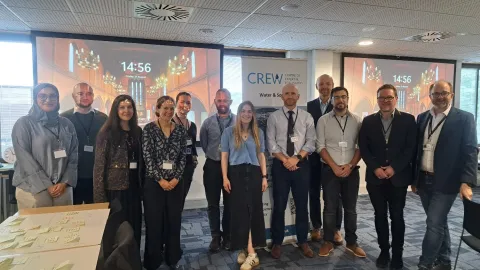
Main image: Members of the Assessing Future Socio-Economic Water Demand in Scotland: Drivers and Patterns project team and steering group.
News Article: Amy Cooper