Flooding & Coastal Erosion

Natural flood management (NFM) knowledge system: The effect of NFM features on the desynchronising of flood peaks at a catchment scale

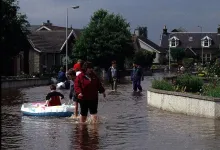
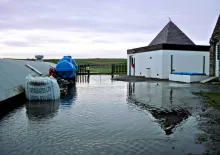
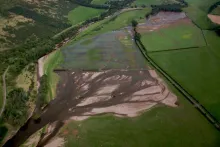
Natural flood management (NFM) is currently being promoted as a cost-effective catchment scale approach to managing flood risk and The Flood Risk Management (Scotland) Act 2009 places an emphasis on all statutory bodies to consider the use of NFM approaches where possible. Whilst this emphasis has already led to a number of initiatives aimed at assessing and promoting the more widespread implementation of NFM techniques within Scotland, there remains significant uncertainty regarding the effectiveness of NFM measures at the catchment scale.
Natural Flood Management - The farmer's view

A new sustainable approach to flood risk management which utilises land management has been brought to the forefront of policy making in Scotland through a policy chain including the EU Water Framework Directive 2000, the Water Environment and Water Services (Scotland) Act 2003, the EU Floods Directive 2007 and the Flood Risk Management (Scotland) Act 2009. This new approach manages risk in an integrated and holistic way, to proactively tackle the causes of flooding. Land use is central.

Evaluating CREW Year 2: Full Report

The Evaluating Science Policy Practice Interface (ESPPI) Project aims to assess how far CREW is meeting its original three objectives, and to make recommendations to the CREW Facilitation Team (CFT) and the CREW Steering Group (CSG) for future improvements. This report is based on the views of people involved in CREW (researchers from the James Hutton Institute and the university sector, and policy / practice customers in the Scottish Government, SEPA and Scottish Water).

Assessing impact of research on policy: a literature review

This review provides insights into how to evaluate the impact made by knowledge created by CREW activities and whether such impact leads to improved environmental, social and economic outcomes via evidence-based water management.   It is widely recognised that impact is more likely to occur when research is co-constructed with research users and is designed with a specific context and use in mind.

Evaluating Knowledge Exchange; A Review

This review brings together literature relevant to evaluating projects and programmes that aim to enhance knowledge exchange (KE) between researchers, policy makers and other stakeholders (i.e. anyone with a ‘stake’ in a process or problem). The review aids the development of evaluation procedures to understand the effectiveness of KE projects implemented by CREW.

Evaluating CREW Year 1 Reports

Scotland’s centre of expertise connecting water research and policy (CREW) delivers objective and robust research and professional opinion to support the development and implementation of water policy in Scotland. Although the importance of demand-driven science to support policy and practice is increasingly recognised, it is not easy to ensure that information is communicated effectively, to the appropriate end-users, in a suitable format, and at the best time to impact on policy or practice.